Tuesday, 19 June 2012

New Book Reveals Buddha’s Advice for a Happy Life


New York, June 19, 2012

The Path to Happiness Begins with Love - New Book Reveals Buddha’s Advice for a Happy Life

'Buddha teaches that a loving heart is a powerful source of happiness. And Eight Steps to Happiness is a practical guide to developing this mind of love. Step one, “Learning to Cherish Others,” teaches how to "develop a realistic view of the world, based on an understanding of the equality and interdependence of all living beings. Once we view each and every living being as important we will naturally develop good intentions toward them,” writes meditation master Geshe Kelsang Gyatso.

“Love is the great protector,” Gyatso explains, “protecting us from anger and jealousy.” With a loving heart we will naturally enjoy everyone we meet, and “difficult” people will disappear—no longer having an ability to cause us pain or upset. Instead of limiting our love to a few people and experiencing only limited happiness, we will learn how our kind heart cherishing others becomes the basis for all our happiness and good qualities. “We [will] have discovered an inexhaustible fountain of happiness within our own mind—our love for others.”

The ultimate goal is not just one's own happiness, but this loving heart will naturally help others experience lasting happiness too. And as love and wisdom grow, people will be able to “remove negativity from the world and give back love and kindness,” Gyatso writes. “We will discover through our own experience that this precious mind of love is the real wish-granting jewel, because it fulfills the pure wishes of both ourself and all living beings.”

Eight Steps to Happiness, based on the classic Buddhist text Eight Verses of Training the Mind, contains “a step-by-step path to complete inner peace and happiness.… Although Eight Verses was written over nine hundred years ago, it is as relevant today as it was then. Whether Buddhist or not, anyone with a genuine wish to overcome their inner problems and achieve permanent inner peace and happiness can benefit from [this] advice,” Gyatso writes...     Full Article

- Sean Robsville

---


---

Monday, 18 June 2012

American Buddhism is Booming


World Peace Temple, New York

From the Washington Post

By William Wilson Quinn

"American Buddhism’s numbers are booming. Published just over three years ago, an American Religious Identification Survey survey showed that from the years 1990 to 2000, Buddhism grew 170 percent in North America. By all indications that remarkable rate of growth continues unabated.

Why is a faith founded under a Bodhi tree in India 2,500 years ago enjoying a newfound popularity in America today?

There is no such thing as a historic North American Buddhist tradition, a fact that is crucial to understanding and facilitating Buddhism’s blossoming. This growth is all the more remarkable given that Buddhism was arguably the most recent import of a major religion to North America from the East..."   


BUT...  'Many U.S. Buddhists say that meditation centers aren’t especially welcoming of children, and some worry it will cost them the next generation of adherents'  Full article


Messy Dharma
Family-friendliness may indeed be a feature of Western Buddhism where there is room for improvement. 

Maybe there are some lessons that Buddhists could learn from Christians regarding family-friendliness.  Many churches in Britain, after a period of long decline, are experiencing growth in membership as a result of 'Messy Church' activities, which provide something for all the family.

I'm not sure how well 'Messy Meditation' would go down with adults (mine's messy enough at the best of times), but perhaps Buddhist based activities for kids could be carried out in parallel to the parents' having a quiet hour to meditate and unwind.       Crafts, music, drama activities (maybe small-scale productions based on Buddhist parables with occasional performances for parents), cookery etc could keep the kids happy while the parents attended drop-in style meditation classes.


TIP - If some aspects of Buddhist beliefs seem unfamiliar, obscure, or confusing, then bear in mind that Buddhism is a process philosophy.   Difficult aspects of Buddhism often become much clearer when viewed from a process perspective.


- Sean Robsville


---


---


Wednesday, 13 June 2012

Buddhists celebrate the Summer Solstice (Midsummer, Litha)


Ancient numinous pagan festivals, with their evocative names
 and customs, offer an escape from the soulless,
 stressed-out, dehumanised,
  over-regulated and proceduralised existence 
that is modern urban life.


Gimme that Old Time Religion

Among people living in northern latitudes, the summer solstice (Midsummer, Litha) has always had a spiritual significance.


Midsummer Eve in Poland - Henryk Siemiradzki


Although not a traditional Buddhist festival, as Buddhism transculturates itself into the West, many Buddhists have begun celebrating the festival as part of their rituals...

Midsummer Eve - Edward Robert Hughes


'We're coming into a very interesting time.
The summer solstice is approaching, and I'd like to talk to you a little bit about the summer solstice. There are four times of tremendous power that occur every year. There are others that occur at different times, but there are four that you can count on, and those are the solstices and the equinoxes.  


'Midsummer Day, the summer solstice, is celebrated annually at Gampo Abbey and across the Shambhala mandala. The event is one of a number which celebrate the change of the seasons...'  


'Maitrivajri writes with news of a cycle of celebration at the FWBO’s London Buddhist Centre: an honouring of the little-known Five Prajnas, the ‘female’ counterparts of the Five Buddhas in the well-known Five-Buddha Mandala.  She says - “This year we are ritually celebrating the female Buddhas, or Prajnas, on the day and time of the year associated with each of them. We began the cycle with the Summer Solstice and female Buddha Mamaki. We are performing outdoor rituals...  
- Female Buddhas celebrated at London Buddhist Centre  


Mamaki - Midsummer Buddha

'There is still a lot of pagan in me, as I've said before. It is still my basic cultural paradigm for interacting with the world with whatever Buddhist sensibilities I've developed on top of it.

I've always appreciated, if not always dramatically celebrated, the wheel of the year as a sensible series of holidays (or "holy days") during the year. Of these, I've always appreciated the solstices the most. They are the points of the greatest light and darkness in our daily experience of the world...'
- Open Buddha    

- Sean Robsville


Related Posts


Tuesday, 12 June 2012

Cats, Categories and Catalogs: Conceptual Designation in Buddhism

The problem of 'universals

- When you see a small feathered creature perched in a tree, how do you know it's a bird?

- When you see a fluffy long-eared creature vanishing down a hole, how do you know it's a rabbit?

- When you taste a cold, sweet vanilla-flavored food with a smooth texture, how do you know it's an ice-cream?

This is the philosophical problem of 'universals', of how our minds assign individual things to general categories, types or kinds.     


These categories, types and kinds of things are known as 'universals', whereas the individual examples are known as 'instantiations' or 'particulars'.  Thus Mungo Jerrie and Rumpelteazer are both instantiations of the universal form of cats.  


Is the universal of bunny formed by the exclusion of non-bunny?


...There are two possible ways for the mind to assign a newly observed phenomenon to a category:

(i)   Look through a mental catalog of everything that is known, and find the closest match. 


(ii)  Use a taxonomic  or cladistic approach of following a decision tree and rejecting everything that is not relevant to identifying the unknown object. This is exemplified by the game of 'Twenty Questions', where every known object can be identified by a process of exclusion using twenty or so mental operations....


Full article at Rational Buddhism

- Sean Robsville
---


---

How so unlike the choral tradition of our own dear Church of England!


"I know the Bible’s right, somebody’s wrong.
I know the Bible’s right, somebody’s wrong.
Romans one and twenty-seven (Rom 1:27)
Ain’t no homo going to make it to heaven."

More at http://www.inquisitr.com/245002/aint-no-homos-gonna-make-it-to-heaven-singing-tot-horrifies-viewers-as-video-goes-viral

- Sean Robsville

---


---

RELATED POST

Queer Dharma and Gay Buddhists


Sunday, 10 June 2012

THE RUGBY LEGEND WHO BECAME A BUDDHIST BY READING QUANTUM PHYSICS


Jonny Wilkinson discovered Buddhism via Quantum Physics

From LankaWeb 
by Walter Jayawardhana

"The rugby legend Jonny Wilkinson hit world headlines due to his 2003 World Cup final heroics, when his drop goal in the last minute of extra-time delivered the trophy to England. He made another sensation when he told the London Times that he became a Buddhist by reading Quantum Physics.

Wilkinson, a millionaire by then, has revealed that he has found inner peace through Buddhism.

The former England Rugby star,  who became a national hero after the world cup victory, said Buddhism  had helped him overcome a fear of failure which was ruining his life ironically due to the victory...'

'...He continued: “I came to understand that I had been living a life in which I barely featured. I had spent my time immersed in the fear of not achieving my goals and then spent my time beating myself up about the mistakes I made along the way. Quantum physics helped me to realise that I was creating this destructive reality and that all I needed to do to change it was to change the way I chose to perceive the world.

‘Failing at something is one thing, but Buddhism tells us that it is up to us how we interpret that failure.

‘The so-called Middle Way is also about having the right intentions.

“[Buddhism] a philosophy and way of life that resonates with me,” he revealed. “I identify with it. I agree with so much of the sentiment behind it. I enjoy the liberating effect it’s had on me to get back into the game...”  Read it all

Wave or particle? - It depends on the mind of the observer


- Sean Robsville


TIP - If some aspects of Buddhist beliefs seem unfamiliar, obscure, or confusing, then bear in mind that Buddhism is a process philosophy.   Difficult aspects of Buddhism (and quantum physics) often become much clearer when viewed from a process perspective.


More on Buddhism and Quantum Physics:


Wednesday, 6 June 2012

Why Do Dead White Males Dominate Philosophy?

Dead White Males


versus


Dead Brown Males


  • Why are the philosophy departments of most universities dominated by Western philosophy?


  • Are all philosophical views just the product of cultural and social factors, or do some of them point to fundamental truths?

  • Should Buddhist philosophy be taught anyhow, even if it is irrelevant to modern life, as a token of diversity, affirmative action and inclusion?

  • Or can Buddhist philosophy be made attractive to Western academia by showing that it is both relevant and original in its approach?


These topics and more are discussed at Rational Buddhism in the comments on an article by philosophy professor Justin E. H. Smith on Western bias in philosophy.


- Sean Robsville


---


---


Saturday, 2 June 2012

Buddhism Banned in Kuwait - 'not sanctioned in the Qur'an'

From Assyrian International News Agency        

"Religious Intolerance is on the Rise in Kuwait
KUWAIT CITY -- Many of America's biggest security threats emanate from its nominal allies, such as Pakistan and Saudi Arabia. Without them neither the Taliban nor al Qaeda would have been nearly so strong.

These countries also are hostile to religious minorities. Other malefactors include Iraq, where the government is a creation of U.S. invasion, and Afghanistan, where the government survives only with allied military support.

Religious intolerance is on the rise even in Kuwait, perhaps America's best friend in the Arab world.

Buddha - not sanctioned in the Qur'an


Until now Christians have worshipped freely in the Persian Gulf state. However, growing threats to religious minorities reflect public attitudes which could undermine the heretofore close U.S.-Kuwait relationship.

Saudi Arabia long has promoted the worst forms of religious intolerance. Spiritual liberty simply doesn't exist. The country is essentially a totalitarian state. The government claims the right to decide the most fundamental questions involving every individual's conscience.

The State Department's latest report on religious freedom observed: "The laws and policies restrict religious freedom, and in practice, the government generally enforced these restrictions. Freedom of religion is neither recognized nor protected under the law and is severely restricted in practice." At best non-Sunni Muslims can hope to be left alone when they worship privately. The group Open Doors placed Saudi Arabia on its "World Watch List," noting simply that "religious freedom does not exist in this heartland of Islam where citizens are only allowed to adhere to one religion."


Dharma - not sanctioned in the Qur'an


Earlier this year the U.S. Commission on International Religious Freedom tagged the kingdom as a "country of particular concern." The Commission found that "systematic, ongoing, and egregious violations of religious freedom continued despite improvements." A decade after 9/11, "the Saudi government has failed to implement a number of promised reforms related to promoting freedom of thought, conscience, and religion or belief. The Saudi government persists in banning all forms of public religious expression other than that of the government's own interpretation of one school of Sunni Islam."

Although Saudi Arabia is the most important Gulf State, it is uniquely intolerant. Most of its neighbors, like Kuwait, allow greater diversity of thought and action. That relative liberality does not go down well in Saudi Arabia.

The Wahhabist Grand Mufti Sheikh Abdul Aziz bin Abdullah Al-Asheikh oversees every Sunni Muslim cleric in Saudi Arabia. He recently stated that it is "necessary to destroy all the churches of the region."


Sangha - not sanctioned in the Qur'an


This judgment came in response to a question from a Kuwaiti delegation of the Wahhabist "Revival of Islamic Heritage Society." Al-Asheikh cited the Hadith, an oral commentary on Mohammad's life, which includes the Prophet's injunction that "There are not to be two religions in the [Arabian] Peninsula." Al-Asheikh's opinion has not been publicized in Saudi Arabia, but his pronouncement already is law there. No Christian churches exist to be torn down.

Sanctioned in the Qur'an


This is not the case in the rest of the Persian Gulf. "Christian churches, Hindu temples and Buddhist shrines are found in Kuwait, Bahrain, the United Arab Emirates, Qatar, Oman, and Yemen," noted Irfan al-Alawi of the Gatestone Institute. In Kuwait there were three churches -- Catholic, Coptic, and Evangelical -- within two blocks of the hotel at which stayed. A few years back I interviewed ministers at all three.


Sanctioned in the Qur'an

In general their relations with the government were very good. The late Jerry Zandstra, then the senior minister at the National Evangelical Church, told me, "We've never had any serious interference at all." The government recently granted a permit to the Catholic Church to construct a new facility. Bishop Camillo Ballin, head of the Apostolic Vicariate of Northern Arabia, noted that he had "never experienced enmity" while acting in Kuwait.


Sanctioned in the Qur'an


Of course, not all is perfect. The State Department reported occasional problems and explained: "The constitution protects freedom of belief, although other laws and policies restrict the free practice of religion." Most important, religions "not sanctioned in the Qur'an," such as Buddhism and Hinduism, "could not build places of worship or other religious facilities," reported State, though worship in private homes was allowed..."

...Well that's really liberal and tolerant of them. At least they don't send the religious thought-police round to your house to stick electrodes  on your head to check whether you've been meditating...


Thought Police checking for Qur'anically unsanctioned meditation?

...yet.


See also:  There will be no future for Buddhism in an Islamized World


Secularized Buddhist Practices adopted by Big Business

...but don't mention the B-word!


From Management Today  
By John Morrish Thursday, 31 May 2012

'Facing a tough economy and heavy workloads, strung-out managers are turning to a range of meditation techniques to help them keep their cool and become better bosses. John Morrish seeks out some headspace.


'Times are fraught, and overstretched executives are constantly on the lookout for a way to clear their minds so they can work in a calmer, more effective, and more responsive way. Cultivating a special state of consciousness called 'mindfulness' - an intense awareness of the here and now - is proving attractive to a growing number of senior managers, both in the US and here.

Mindfulness is achieved by meditation techniques, often involving sitting on a cushion, eyes closed, concentrating on the inflow and outflow of your breath. Or you might spend 10 minutes studying, sniffing, tasting and finally eating a piece of fruit. That might make it sound like a remnant of the hippy-dippy, navel-gazing 1960s and 1970s, but the evidence for mindfulness's effectiveness is good enough to have impressed hard-nosed companies such as Google (which has invited mindfulness gurus to speak at the Googleplex), General Mills, PricewaterhouseCoopers, Deutsche Bank, Procter & Gamble, AstraZeneca, Apple, Credit Suisse, KPMG, Innocent, Reuters and many more.

According to Don McCormick, assistant professor of management at California State University and a dedicated meditator, it 'can help individuals to manage workplace stress, perform tasks more effectively, enhance self-awareness and self-regulation, experience work as more meaningful, improve workplace relationships, increase ethical behaviour, and make perception more accurate'. It is said to pay dividends for leaders and managers, by improving the quality of their listening and communicating.

Impressive claims, then. But what exactly is mindfulness? Michael Chaskalson, an experienced British mindfulness teacher and the author of a powerful little book called The Mindful Workplace (Wiley-Blackwell), says it is 'a way of paying attention to yourself, to others and to the world around you. And it's a quality of attention which is open, kindly and non-judgemental.' McCormick uses a mnemonic, Canape, when explaining it to his students: 'Concentrated Awareness of experience, Non-judgemental and Accepting in the Present moment, and characterised by Equanimity.' Hardly snappy, but it seems to work.

Business people who have taken up mindfulness meditation find it has helped them in different ways. David Huntley is one enthusiast. An actuary by profession, he has had a 25-year career in financial services, running the Australian and New Zealand businesses of Swiss Re and becoming head of Pearl Life after Pearl took over Resolution in 2008. Now he has a portfolio career, including coaching, working with a start-up business and taking on his first non-executive role. In 2006, newly back in Britain from Australia, he was introduced by his own business coach to Chaskalson. 'Within a week or so, I was sitting in a hotel room studying a raisin for 10 minutes, thinking, crikey, how much are we paying the guy?'

But he persisted with a range of meditation practices, including 'body-scanning', in which you focus on the sensations in various parts of your body, and 'sitting meditation', in which, initially, you focus all your attention on your breath. Something called the 'three-minute meditation' proved especially helpful. 'If I had a big meeting coming up, I'd nip into the gents and sit there and do it. I definitely felt calmer, more present and more centred.'

He liked it so much that earlier this year he went back for an eight-week course intended for business coaches. It has given him more focus, he says. 'I feel that I'm using a number of senses to be with clients, rather than just listening to what they say.'

Business, Huntley says, works at two levels: propositional and implicational. The propositional level is about setting out plans and projects; the implicational level is about what people think of each other, what people say about each other, how messages are received. 'So you've got this noise going on at this implicational level,' he says. 'Mindfulness has the capacity to calm that noise down and enable you to work more in the moment without that noise going on.'

While it may be a hot business trend, the roots of mindfulness go deep. It originated in the teachings of the Buddha 2,500 years ago, and similar ideas and practices are found in many religions. But the mindfulness being offered to business people is a secularised version, shorn of religious language, though many of its teachers it have Buddhist backgrounds.

Chaskalson has been a Buddhist since 1975. He created and ran an ethical import business before becoming a full-time mindfulness teacher. He teaches a course at Bangor University and runs a company offering business coaching.

He says: 'When you are better at working with your mind and mental states, things go better for you. If what you are after is greater emotional intelligence in your people, a greater capacity to empathise and connect with others and for them to regulate their own emotions, we know that mindfulness training will help.'

In the US, Michael Carroll, author of The Mindful Leader (Shambhala Publications), is a former Wall Street and Disney executive. Another Buddhist, he is a believer in a serious regime of practice 'on the cushion'. He emphasises that mindfulness is about being rather than doing.

'Business people are good at getting stuff done, meeting objectives, hitting the numbers, closing the deal. This is a different type of effort. It's not the effort of how to get somewhere, it's the effort of how to be somewhere. 'Out of that sense of presence and seeing clearly, we begin to notice that the social intelligence skills that we require begin to naturally manifest (themselves), because we are paying attention. We're listening to someone and we're resonating with their unspoken message, because we're not rushing past that to our goal.'

Reaching that state of calm is not always easy. Formal meditation can be boring and frustrating. You will probably fall asleep when you start. But all you have to do is keep doing it, it is said, to see its benefits permeating your daily life. In an analogy originated by Jon Kabat-Zinn, effectively the inventor of modern, secular mindfulness, it is better to weave your parachute before you jump out of the plane.

Kabat-Zinn is a medical scientist and a Buddhist. Creating a clinic at his Massachusetts hospital in 1979, he adapted the practice of mindfulness meditation from Buddhism, removed its religious trappings, and began using it in the treatment of chronic pain, then stress. Since then, mindfulness has been used for anxiety, depression - where it is recommended by Britain's NICE - sleeplessness, relationship problems, eating disorders and many more.

More recently, it has appeared in other areas. In the US, it has been used in education, in the prison and police services, by trial lawyers and even by marines heading for Iraq: the idea was to make them more resilient and able to cope with the extreme stress of battle.

Kabat-Zinn's background led him to insist that the benefits of mindfulness meditation should be measured scientifically: there are now hundreds of academic papers attesting to its worth. It is even claimed that after a standard Kabat-Zinn programme of eight two-hour sessions, held once a week and supported by daily homework, the brain itself expands in the areas associated with learning, memory, self-awareness, compassion and introspection.

Andy Parsons is a pharmacologist and neuroscientist and a vice-president at GlaxoSmithKline. An internal coach at GSK, he says that for him mindfulness is about 'being completely present and listening to what's going on around you. Being truly present and mindful allows you to really focus without running scripts from past experiences.'.....   Full article


It's Dharma, Jim, but not as we know it.
So should Buddhist techniques of mind-management be presented without any reference to their origin?  

Is this a form of plagiarism? 

Or is it skillful means to sneak dharma-teachings into the secular establishment under the radar of the religion detectors?   If people learn a little about meditation techniques, might they want to find out more?

- Sean Robsville
---


---


Buddhist Temple Art in Vietnam - Vinh Nghiem
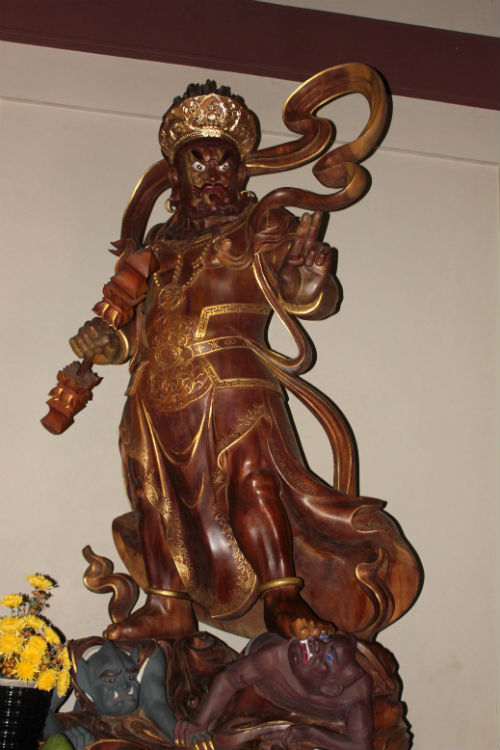
From Vietnamnet  

Views of sacred Buddhist art in Hue Nghiem Temple,  Binh Tan district, Ho Chi Minh City, Vietnam


Hue Nghiem


Three-door gate of the institute


Bell Tower


Buddha Shakyamuni


 A Buddha statue at the center of the institute. The statue is 2.3m high, 1.8 tons in weight, standing on a 200-petal lotus. Each petal is carved with Sakyamuni Buddha.


5,400 words from a prayer book are carved and inlaid with gold on the dome above the Buddha statue.


 Statues carved on the stone three-step staircases.


Four Buddha statues on a 2.2m high, 2 ton lotus, with 1,000 petals. Each petal is also carved with Sakyamuni Buddha. 


 If you're wondering about the swastika, don't worry. Buddha wasn't a member of a far-right organization!
The swastika has been a Buddhist auspicious symbol for 2000 years before the Nazis stole it.


Three Buddhas in the main temple


Four directional guardians


Fierce protectors


Gold inlaid prayers on wall


Carved ironwood doors


...open up to...


Maitreya


Details of ironwood door carvings


Full article at Vietnamnet  

- Sean Robsville

Related Post